| View previous topic :: View next topic |
| Author |
Message |
AntKiller
Junior Member
Joined: 11 Apr 2011
Posts: 4
Location: S. FL
|
 Posted: Mon Apr 11, 2011 11:56 am Post subject: First violin Fingerboard fell off Posted: Mon Apr 11, 2011 11:56 am Post subject: First violin Fingerboard fell off |
 |
|
Hi all, My name is Anthony I'm 29 and a South Florida upright bass player, finish carpenter and wannabe luthier. I have recently completed my first violin. It was a gift for my mother who has been playing since I was a small child. It has a couple of discrepancies from most violins the two main ones being: the plate overhang is too big and there is no button.
The Violin has a cedar top, and maple ribs and back. For ease of carving my first scroll, I used White Mohagany(tight grained, slightly stringy, medium density)for the neck and scroll. I used behlen ground hide glue and so far all joints showed no sign of weakening or shifting. I made my own fingerboard and tail piece out of Pau Lope (some people call it ironwood, close cousin to Ipe). Three days after completion, the fingerboard de-laminated. I surely will have no problem re-gluing. My question is.. Is this a common occurrence, or more of a fluke type of thing. Could this be caused from the non-maple neck flexing under string tension? I did not knurl the hard/oily surface of the back of the fingerboard, should I have? I also have a theory that there may have been some residual oils on the gluing surface(mainly the Pau Lope), would that compromise the glue joint?
 |
|
| Back to top |
|
 |
FiddleDoug
Member
Joined: 08 Sep 2007
Posts: 227
Location: Hilton, NY
|
| Posted: Mon Apr 11, 2011 1:16 pm Post subject: |
|
|
First question is- why no button? The button is significant in the strength of the neck/body joint against the tension of the strings. I would guess that you may be right about the oily wood not accepting the glue properly. At the very least, you should probably wash the surfaces really well with acetone before gluing.
_________________
Doug Wall
www.wallindependent.com |
|
| Back to top |
|
|
Benedict White
Member
Joined: 27 Jan 2011
Posts: 113
|
| Posted: Mon Apr 11, 2011 5:43 pm Post subject: |
|
|
You should not oil or varnish where you are going to glue.
If you clean it off as suggested you could also try a very thin coat of glue to "size" the joint first. (I am sure I have used the wrong word but that is what it sounds like). |
|
| Back to top |
|
|
AntKiller
Junior Member
Joined: 11 Apr 2011
Posts: 4
Location: S. FL
|
| Posted: Mon Apr 11, 2011 6:35 pm Post subject: |
|
|
There is no button, because I simply overlooked it. No other excuse. I can assure you that this will be my only violin without a button. The good news is that my overhang is around 6mm. So I have at least 6mm of adhesion in that area of the heel.
Doug, Thank you for the tip. After inspecting, all of the glue adhered to the neck side and not one bit on the fingerboard. That leads me to believe that I either did not or at best poorly prepped the joint. I will properly prep both sides this time around.
Benedict, I'm pretty sure both areas were varnish free. I the oils that I was referring to were hand oil and the natural oils in the Pau Lope. Would you mind explaining to me this "sizing"(maybe seize) technique in further detail?
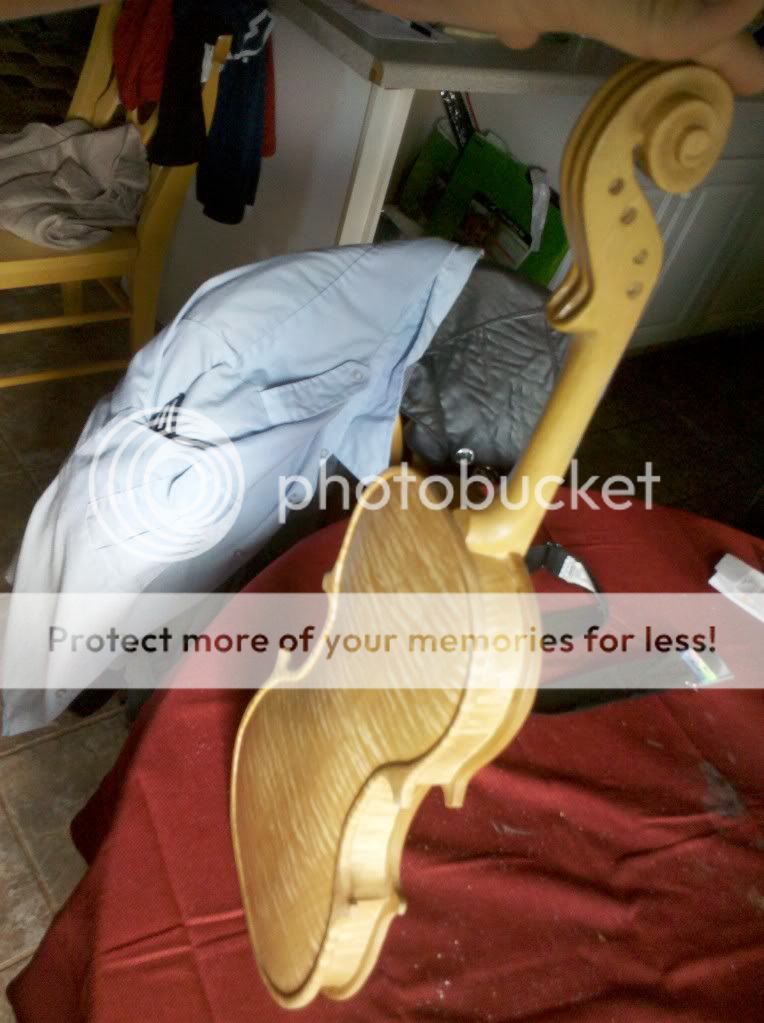
Here's a shot of the back in the early finishing stages |
|
| Back to top |
|
|
Dave Chandler
Super Member
Joined: 31 Oct 2007
Posts: 691
Location: Mt Mitchell in North Carolina
|
| Posted: Mon Apr 11, 2011 6:35 pm Post subject: |
|
|
I've had a fingerboard pop off, just used too thin a glue along with a cold joint. Really a surprise for the player! Its one of the least serious issues you could have. I scrape the surface clean, heat it slightly with a heat gun (be careful of the varnish) and reglue. I've "sized" too, but that has to be really thin or it'll keep you from closing the gap when you glue and clamp.
Cool "f" holes, what pattern did you use?
The button -- I've cut back wood and forgot the button -- you only do this once. Curious how you got so far into the project without a button. I think at some point you'll need to go back in and do some sort of reinforcement or the torque of the neck will eventually pull things apart, probably sooner than later.
_________________
Dave in the Blue Ridge
Southern Violin Association
"Success is the ability to go from one failure to the next with no loss of enthusiasm" Winston Churchill
"I took the road less travelled, and now I don't know where I am." Marco Polo |
|
| Back to top |
|
|
Dave Chandler
Super Member
Joined: 31 Oct 2007
Posts: 691
Location: Mt Mitchell in North Carolina
|
| Posted: Mon Apr 11, 2011 6:37 pm Post subject: |
|
|
How about that, simultaneous postings!
_________________
Dave in the Blue Ridge
Southern Violin Association
"Success is the ability to go from one failure to the next with no loss of enthusiasm" Winston Churchill
"I took the road less travelled, and now I don't know where I am." Marco Polo |
|
| Back to top |
|
|
Benedict White
Member
Joined: 27 Jan 2011
Posts: 113
|
| Posted: Mon Apr 11, 2011 7:24 pm Post subject: |
|
|
Sizing refers to a really thinned coat applied to an absorbent surface so that it does not absorb all the glue into the material leaving nothing to make the joint.
That said, you should use hot hide glue and clamp the joint for a day. If you scrape the joint clean first you should be OK. Also as Dave mentioned a fingerboard popping off is not a major issue. |
|
| Back to top |
|
|
AntKiller
Junior Member
Joined: 11 Apr 2011
Posts: 4
Location: S. FL
|
| Posted: Mon Apr 11, 2011 7:45 pm Post subject: |
|
|
Simultaneous posts, crazy..Yes, I regretfully lacked guidance on this one. I thought about adding a faux-button, but I wasn't sure about how much it would actually help. Creatively dovetail it?
I did not use any patterns. I used a Chinese loose version of a Strad. copy(14'', 13 1/8'' scale. Viola?) for some general dimensions. I shrunk it a little(13 3/4", 12.8'' scale) and added to the upper bout. I also increased the height of the top plate arch while lowering the rib height. I also used the "chinagal" for some dimensions for the ff holes, but ultimately adding and talking away were I felt necessary. I really liked the wide area at the notch in the ff holes when I was setting the sound post.
I'm sorry for using inches in this post. I try to explain as much as I can in mm.s, but I built it using inches. |
|
| Back to top |
|
|
Mat Roop
Senior Member
Joined: 24 Mar 2007
Posts: 911
Location: Wyoming Ontario
|
| Posted: Mon Apr 11, 2011 10:13 pm Post subject: |
|
|
antkiller... did you heat the fingerboard and the neck before applying the glue... what temperature was the glue?
If the fingerboard was cold and the glue was applied to the neck, It is possible that a thin layer of glue next to the fingerboard set before it could adhere properly.
When you reglue, be sure any wood oils are washed off as previously mentioned and your hide glue is hot (max 60 deg F)... and heat both gluing surfaces thoroughly, lather on the glue, clamp and move into position and don't shift once in place.
Good luck!... Mat |
|
| Back to top |
|
|
AntKiller
Junior Member
Joined: 11 Apr 2011
Posts: 4
Location: S. FL
|
| Posted: Tue Apr 12, 2011 9:41 am Post subject: |
|
|
Thank you all for the advice. Its really nice to know that people are willing to share this very valuable knowledge. The fingerboard is back on. I scraped off the old glue, prepped both sides(sanding block and acetone). I hadn't been soaking my glue granules prior to heating( I was using it as per the instructions on the can). I read about it in the hide glue section. It really adds consistency and working time to the glue.
Thanks Again |
|
| Back to top |
|
|
Dave Chandler
Super Member
Joined: 31 Oct 2007
Posts: 691
Location: Mt Mitchell in North Carolina
|
| Posted: Tue Apr 12, 2011 4:30 pm Post subject: |
|
|
If the neck is well attached to the block, and the plates to the block as well, it may be OK in the short run. I'm sure there's a way to do add a button that really works. Thinking.....
_________________
Dave in the Blue Ridge
Southern Violin Association
"Success is the ability to go from one failure to the next with no loss of enthusiasm" Winston Churchill
"I took the road less travelled, and now I don't know where I am." Marco Polo |
|
| Back to top |
|
|
|

 FAQ
FAQ Search
 Memberlist
 Usergroups
 Register
 Profile
 Log in to check your private messages
 Log in


